Optimising PHA at Gram Scale with Xplore
Published: February 5, 2026 · Reading time: 3 minutes
“The small capacity of Xplore’s equipment helped us optimize our formulations with just a few grams of PHA, allowing us to do a wider variety of trials with less time, less effort, and fewer materials.”
— Reza Beigi, Product Lead, Uluu
Introduction
Working with extremely limited material quantities, Uluu relied on lab-scale PHA processing to optimise formulations, evaluate additives, and gain real-time insight into material behaviour. Using Xplore’s compounding and injection moulding systems, the team enabled meaningful, data-driven polymer R&D at the gram scale, without scaling up too early.
Uluu develops seaweed-derived polyhydroxyalkanoates (PHAs) as a sustainable alternative to conventional plastics. These materials combine plastic-like performance with biocompatibility, climate positivity, and full biodegradability.
At an early stage of development, however, innovation depended on the ability to test and understand material behaviour using extremely small quantities. This is where Xplore Instruments became a key part of Uluu’s research workflow.
From 10 Grams per Week to Practical Formulation R&D
In 2022, Uluu was producing approximately 10 grams of PHA per week. Conventional polymer processing equipment was therefore impractical. Despite this limitation, the team needed to optimise formulations, explore additives, and evaluate performance, without wasting valuable material.
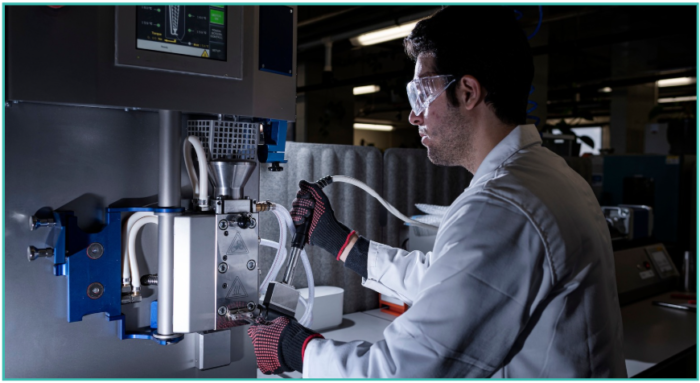
Figure 1. Lab-scale PHA formulation work at Uluu using Xplore Micro-Compounding equipment
Xplore’s lab-scale screw compounder enabled formulation optimisation using just a few grams of polymer, allowing Uluu to run multiple trials efficiently and compare formulations without being constrained by material availability.
Why Xplore: Designed for Minimal Material Volumes
Uluu identified Xplore through a technical search for the smallest possible compounding solutions. What stood out was the ability of Xplore’s lab-scale instruments to maintain controlled mixing and good dispersion, even when working with milligram-scale secondary materials.
Responsiveness also played a role: from early discussions through installation, Xplore’s technical team provided fast and knowledgeable support, critical in a fast-moving R&D environment.
Enabling Real Research and Process Insight
Xplore’s equipment quickly became central to Uluu’s material development work. In one project, the team investigated how adding another material affected PHA mechanical properties. Using the micro-compounder, Uluu processed grams of PHA combined with milligrams of additive, while maintaining good dispersion and reliable results, without premature scale-up.
The lab-scale injection moulding system further supported this work by enabling frequent production of mechanical test specimens, improving iteration speed and data quality.
A key advantage was real-time viscosity monitoring during compounding, which provided immediate insight into whether a formulation behaved as a high-flow or low-flow material, helping guide formulation decisions and reduce trial-and-error.
Enabling Early-Stage Material Innovation
Uluu’s experience shows how lab-scale polymer processing can remove a major bottleneck in early-stage materials development. By enabling meaningful compounding, testing, and process insight with only a few grams of material, Xplore’s systems allowed the team to focus on learning and optimisation rather than material limitations.
For researchers working with novel polymers or scarce feedstocks, this approach demonstrates how gram-scale processing can support faster iteration, deeper material understanding, and more efficient innovation, without scaling up too early.
This article is based on an interview with Reza Beigi, Product Lead at Uluu.
Interested in how Xplore can support your lab-scale polymer development? Get in touch with us.