Lab-Scale Thermoplastic UD Tape Development
Published: April 3, 2026 · Reading time: 2 minutes
Introduction
Unidirectional (UD) thermoplastic tapes are increasingly recognized as key building blocks for next-generation composite structures in aerospace, automotive, energy, and industrial applications. Their high fiber alignment, excellent load transfer efficiency, and compatibility with automated manufacturing processes make them ideal for lightweight, high-performance designs [1].
However, the successful development of UD tapes is highly dependent on precise control over material formulation, impregnation quality, and processing parameters. In this context, lab-scale UD tape development plays a critical role in accelerating innovation while minimizing material consumption, cost, and risk.
Why UD Tape Development is Challenging
Producing high-quality UD tapes (Fig. 1) requires achieving uniform fiber impregnation and consistent fiber distribution within a thermoplastic matrix. Several interrelated challenges must be addressed:
- High melt viscosity of thermoplastics limits fiber wetting
- Short residence times during processing restrict impregnation efficiency
- Fiber spreading and tension control directly affect tape uniformity [2]
- Void formation can significantly reduce mechanical performance
- Interfacial adhesion between fiber and matrix must be optimized
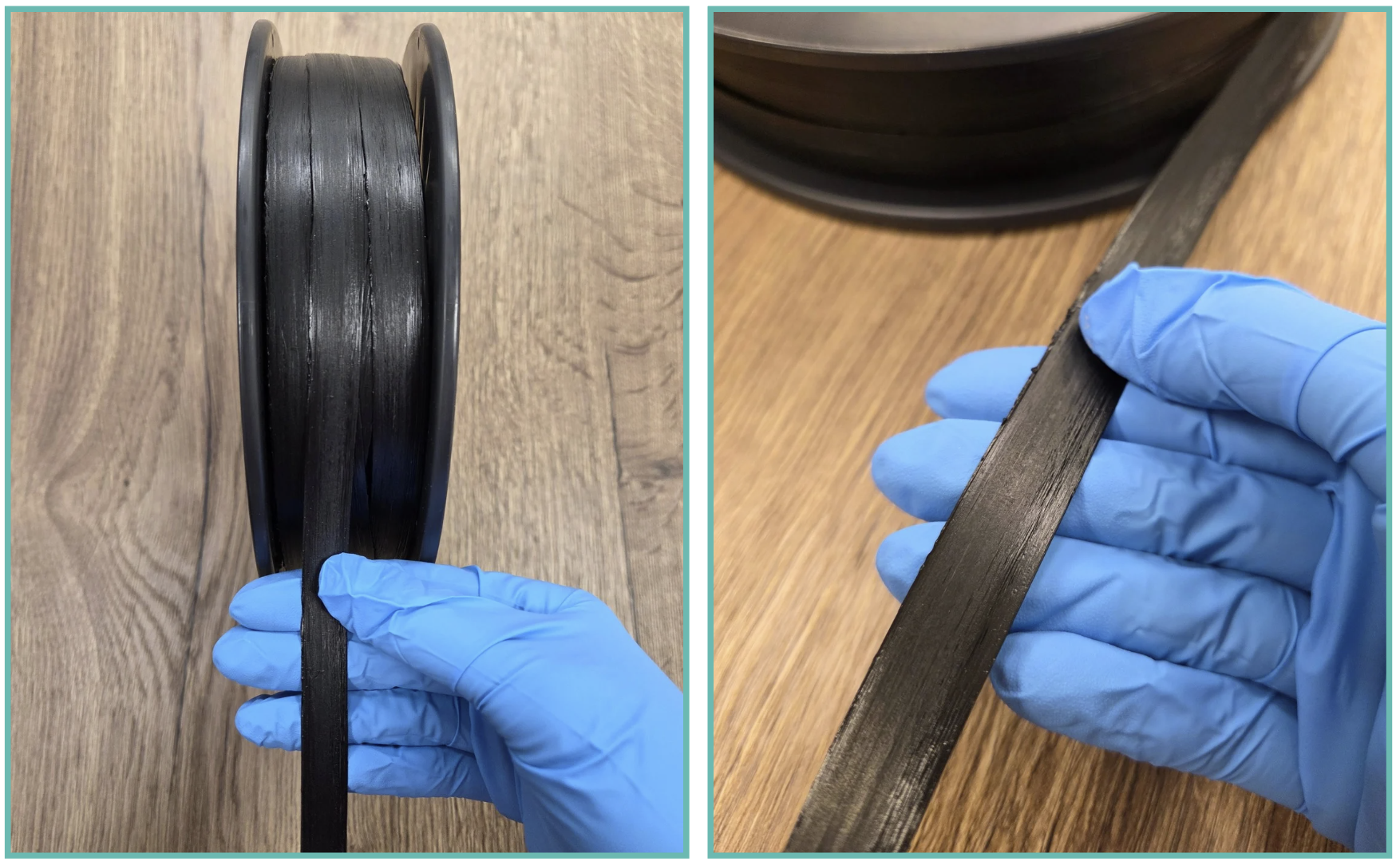
Figure 1. Example of UD tapes produced using Xplore’s UD Tape Line.
Role of Lab-Scale Processing
Lab-scale UD tape systems provide a controlled and flexible environment to systematically study and optimize these parameters before scaling up.
Material Efficiency and Cost Reduction: High-performance polymers and carbon fibers are expensive. Lab-scale systems allow development using grams instead of kilograms and reduce material waste.
Precise Control of Processing Parameters: Temperature, shear rate, residence time, and fiber tension can be finely tuned to study their effects.
Understanding Impregnation Mechanisms: Lab-scale setups enable investigation of polymer flow into fiber bundles and effects of viscosity, pressure, and surface treatments.
Rapid Screening and Optimization: Multiple formulations, fiber types, and additives can be evaluated quickly, accelerating development.
From Lab to Pilot and Industrial Scale
Modern lab-scale systems generate scale-relevant data, reducing scale-up risks and development time. By replicating key processing conditions such as shear history, temperature profiles, and residence time, researchers can better predict how materials will behave in pilot and full-scale production. This continuity enables more confident decision-making when transitioning from formulation development to manufacturing, minimizing costly trial-and-error iterations. As a result, development cycles become shorter, more efficient, and more reliable.
Impact on Composite Performance
Optimized UD tapes improve mechanical properties, interlaminar bonding, and reduce defects, ensuring consistency. Enhanced fiber impregnation and uniform distribution directly contribute to higher strength, stiffness, and durability of the final composite structures. In addition, controlling void content and interfacial adhesion improves long-term performance and reliability under demanding conditions. These improvements are critical for applications where structural integrity, weight reduction, and reproducibility are essential.
Xplore’s UD Tape Line
Xplore technologies enable minimal material usage, controlled processing, and reliable scale-up. Through the Synergia Programme, customers can initiate projects with experts before investing in equipment.
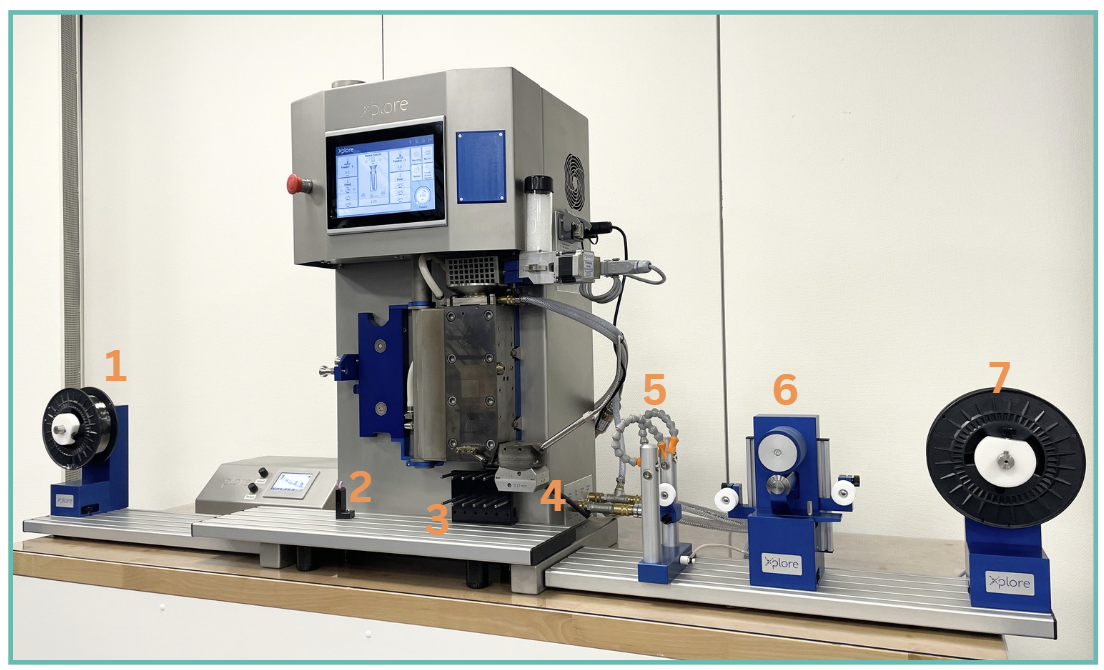
Figure 2. Xplore’s UD Tape Line
- Tension-controlled unwinding unit: Provides the required tension to enable proper fiber spreading.
- Pigtail assembly: Ensures proper alignment of the fiber tow.
- Spreader box: Features a flexible design that allows adjustment of the position and number of spreader bars.
- UD Tape Die
- Air pillars: Enable cooling using multiple cooling pillars or air hoses.
- Transport godet: Controls the line speed.
- Winding godet: Is torque-controlled and collects the final product.
Lab-scale UD tape development is a strategic enabler of innovation, bridging the gap between concept and production and accelerating the development of high-performance thermoplastic composites.
References
- Khursid, M., Abdkader, A. & Cherif, C., (2019) “5A1_0483_ Process development for uni directional tape structure based on recycled carbon fiber and thermoplastic fibers for fiber reinforced plastics”, Proceedings of the 19th World Textile Conference – Autex 2019 , 7. Link
- Clancy, G., Peeters, D., O’Higgins, R. M., & Weaver, P. M. (2020). In-line variable spreading of carbon fibre/thermoplastic pre-preg tapes for application in automatic tape placement. Materials and Design, 194, Article 108967. Link