What If You Could See Color Develop During Compounding?
Published: June 4, 2026 · Reading time: 3 minutes
Introduction
Color matching in polymer development is an iterative process that requires precise control of pigment concentrations, dispersion quality, and processing conditions. Traditionally, achieving a target color often involves multiple compounding trials, significant material consumption, and lengthy development cycles.
By combining Xplore micro-compounders with inline UV-Vis spectroscopy, formulators can accelerate color development while reducing material usage and obtaining immediate feedback on color performance.
The Science Behind Accurate Color Matching
Color is how our eyes interpret light. When light hits a surface, certain wavelengths are absorbed and others are reflected. Those reflected wavelengths reach our eyes and are processed by the brain as color. In materials and plastics, pigments and dyes selectively absorb parts of the visible spectrum (roughly 380 to 700 nm), producing the colors we perceive.
A color space is a mathematical model that allows us to describe and communicate color numerically. The most widely used in industry is CIE Lab* (CIELAB): L* represents lightness, a* the green-red axis, and b* the blue-yellow axis. By expressing color as coordinates, we can quantify the difference between a target color and a sample, known as Delta E. The lower the Delta E, the closer the match. This transforms color matching from a subjective judgment into a precise, reproducible measurement.
Accelerating Color Matching with Xplore Micro-Compounders
Color matching in polymers is an iterative process. Formulators adjust pigment concentrations, carrier resins, and additives until the target color is achieved. Traditionally, this requires producing large batches and significant material waste per iteration.
Xplore micro-compounders change this fundamentally. With batch sizes as small as 5 to 15 ml, R&D teams can compound and test dozens of color formulations in a single day, using only milligrams of precious pigment or specialty resin. Crucially, the mixing action itself allows rapid iteration: pigment ratios can be adjusted on the fly during mixing, so formulators are not locked into fixed batch compositions. The system is also designed for fast, easy cleaning between batches, with no cross-contamination risk and no lengthy downtime. The next color trial can start within minutes.
Inline UV-Vis Spectroscopy for Real-Time Feedback
Speed alone is not enough. Accurate and immediate color feedback is equally important.
Inline UV-Vis probes measure color directly during or immediately after compounding, without the need to press plaques or prepare external samples. They capture the full spectral signature of the melt or compound and map it to standard color space coordinates instantly.
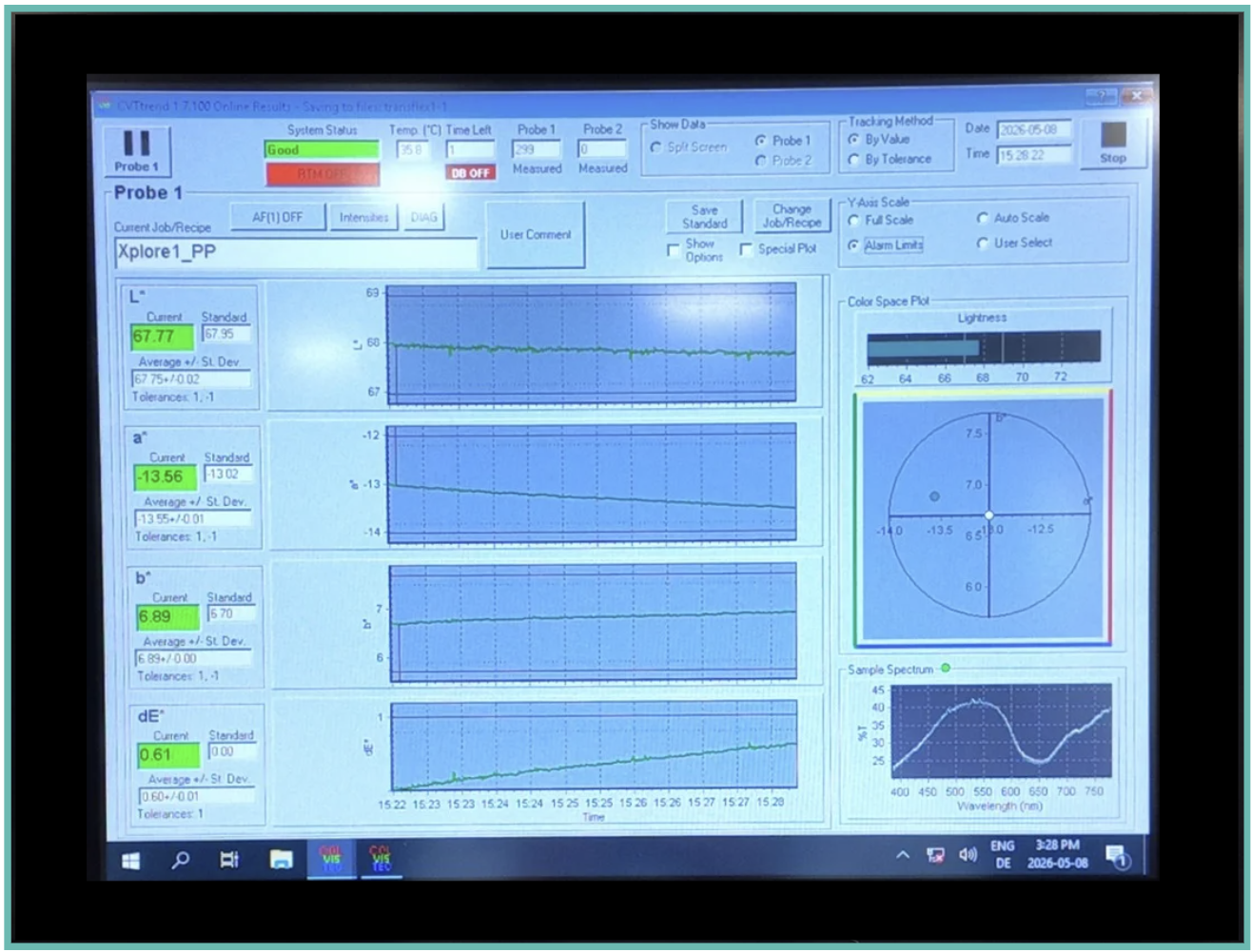
Figure 1. Color analysis interface of a ColVisTec inline UV-Vis system
Combining Processing and Color Analysis
Combined with Xplore micro-compounders, inline UV-Vis probes create a closed-loop workflow: compound a small batch, measure color inline, adjust the formulation mid-process if needed, clean rapidly, and iterate. Each adjustment is guided by real spectral data, allowing convergence towards the target color significantly faster than traditional trial-and-error approaches.
Conclusion
Color matching in polymer development has historically been slow, material-intensive, and reliant on skilled visual judgment. The combination of Xplore micro-compounders and inline UV-Vis probes provides a fast, data-driven workflow that enables rapid formulation development, real-time color monitoring, and improved reproducibility. Formulators gain the speed and precision required to achieve accurate color matching from the earliest stages of development.
References
- Agate, S., Williams, A., Dougherty, J., Velev, O.D., and Pal, L. (2023). “Polymer Color Intelligence: Effect of Materials, Instruments, and Measurement Techniques — A Review.” ACS Omega, 8(26), 23257–23270. Link
- Alsadi, J. et al. (2021). “Experimental Assessment of Pigment Dispersion in Compounding of Plastics: Rheological Characterization at the Crossover Points.” Materials Today: Proceedings. Link
- Neo, P.K., Kitada, Y., Deeying, J., Thumsorn, S., et al. (2023). “Influence of Compounding Parameters on Color Space and Properties of Thermoplastics with Ultramarine Blue Pigment.” Polymers, 15(24), 4718. Link