What is Reactive Extrusion?
Published: June 18, 2026 · Reading time: 5 minutes
Introduction
Reactive extrusion has evolved from a specialized processing technique into a key technology for modern polymer development. By combining chemical reactions and melt processing within a single operation, reactive extrusion enables researchers and manufacturers to modify polymer structures, improve material properties, and develop new formulations without separate synthesis and processing steps.
Unlike conventional compounding, where the primary objective is mixing and shaping, reactive extrusion intentionally utilizes temperature, shear, residence time, and reactive additives to induce chemical changes within the polymer melt. Because these reactions occur directly in the melt phase, reactive extrusion offers a solvent-free, continuous, and scalable route for material modification. As sustainability and material performance become increasingly important, reactive extrusion continues to play a central role in industrial polymer innovation.
Common Reactive Extrusion Mechanisms
Reactive extrusion can be used to induce a variety of chemical transformations directly within the polymer melt. Depending on the formulation and processing conditions, these reactions can modify molecular architecture, improve compatibility between materials, or introduce new functionalities.
Common reactive extrusion mechanisms include:
- Chain extension
- Branching
- Compatibilization
- Crosslinking
- Functionalization
- Grafting
- Polymerization and oligomerization
- Controlled degradation
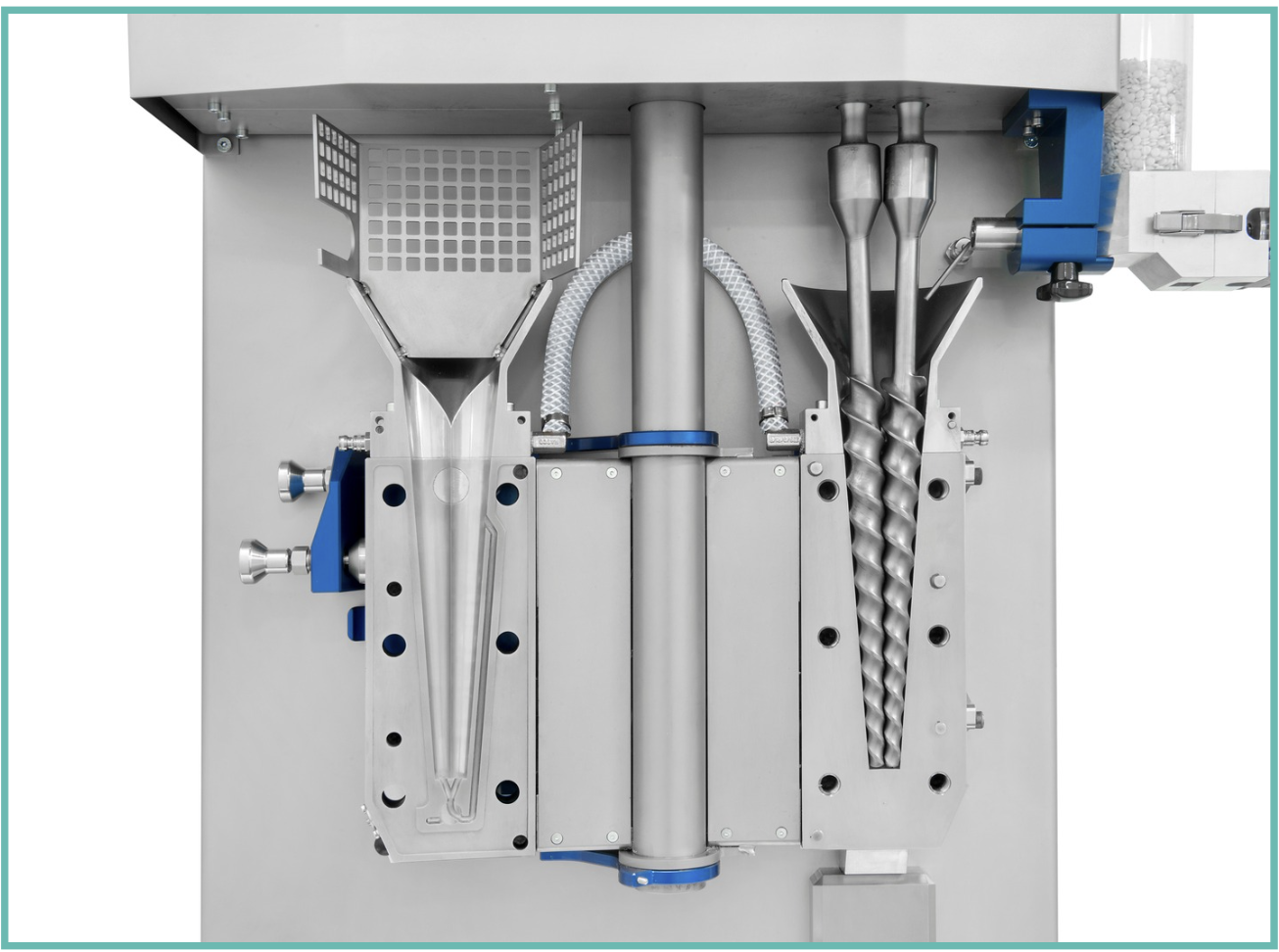
Figure 1. Open barrel and screw configuration of an Xplore micro-compounder.
Applications of Reactive Extrusion
Reactive extrusion is widely implemented across numerous polymer industries, enabling both material enhancement and sustainable manufacturing approaches.
Polymer Recycling
One of the most important applications is the restoration of degraded polymers during mechanical recycling. Chain extenders, multifunctional epoxies, carbodiimides, and peroxide systems are commonly introduced during extrusion to rebuild molecular weight and improve processability.
Some examples include:
- Recycling of PET and polyester blends [1, 2]
- Recycling and upcycling of polyolefins [3]
- Recycled polyamides
- Mixed plastic waste streams
Polymer Blends Compatibilization and Nanocomposites Development
Many polymer blends exhibit poor interfacial adhesion due to the inherent incompatibility between their constituent phases. Reactive compatibilization can generate in-situ copolymers during processing, improving interfacial adhesion, phase dispersion, and ultimately the mechanical performance of the final material. A common example is the compatibilization of PET/PE blends through reactive extrusion [4].
Reactive extrusion is also widely used in the development of polymer composites and nanocomposites, where it can enhance filler dispersion and strengthen the interfacial interactions between the polymer matrix and reinforcing phases. This approach has been successfully applied in the preparation of bio-nanocomposites [5], as well as:
- Carbon nanotube composites
- Graphene nanocomposites
- Natural fiber composites
- Glass and carbon fiber systems
Functional Polymers and Vitrimers
Reactive extrusion is also used to introduce specific chemical functionalities into polymers for advanced applications. More recently, it has become an attractive route for the preparation of vitrimers and other dynamic covalent polymer networks. During processing, functional groups, crosslinkers, and catalysts can react within the melt to form reversible covalent bonds, enabling reprocessability, self-healing behavior, improved repairability, and enhanced recyclability.
Examples include:
- Biomedical materials [6]
- Sustainable packaging [7]
- Vitrimers fabrication [8]
- Conductive compounds
- Battery materials
Why Micro-Compounding is Ideal for Reactive Extrusion
Despite its advantages, reactive extrusion development can be challenging. Chemical reactions are highly sensitive to processing conditions such as temperature, shear rate, residence time, and atmosphere. Conventional extrusion trials often require kilograms of material (which are in some cases very expensive) and extensive experimental campaigns, making formulation optimization both costly and time-consuming.
Micro-compounders provide an attractive alternative by enabling reactive extrusion studies using only grams of material.
Key advantages include:
- Minimal material consumption and rapid formulation screening
- Precise residence time control
- Inline rheological properties monitoring
- Compatibility with downstream shaping technologies such as cast film extrusion, fiber spinning, pelletizing, and injection moulding
Xplore micro-compounders are particularly well suited for reactive extrusion studies due to their unique combination of process control, material efficiency, and analytical capabilities.
The recirculation capability of Xplore’s micro-compounders is especially valuable because it extends the observation window, allowing researchers to investigate reaction kinetics and material evolution under well-controlled conditions. By independently adjusting temperature, screw speed, and recirculation time, users can systematically study the influence of processing conditions on reaction progress and final material properties.
In addition, Xplore’s rheological software enables continuous monitoring of viscosity development during a reactive extrusion trial. Changes in viscosity can provide direct insight into chain extension, branching, crosslinking, degradation, or compatibilization reactions occurring within the melt.
When combined with inline spectroscopic techniques such as NIR, Raman, or UV-Vis spectroscopy, researchers can simultaneously monitor rheological evolution and chemical transformations during processing. This enables direct correlation between chemical reactions and material performance, providing a powerful framework for studying reaction kinetics and optimizing formulations in real time.
References
- Berg, Dennis, Karola Schaefer, and Martin Moeller. “Impact of the chain extension of poly (ethylene terephthalate) with 1, 3‐phenylene‐bis‐oxazoline and N, N′‐carbonylbiscaprolactam by reactive extrusion on its properties.” Polymer Engineering & Science 59.2 (2019): 284-294. Link
- Himmelsbach, Andreas, et al. “Kinetic Analysis of PMDA-Induced Chain Extension in Polyester Blends: Differential Reactivity of rPET and PBT during Reactive Extrusion.” Industrial & Engineering Chemistry Research 64.5 (2025): 2553-2560. Link
- Vialon, Thomas, et al. “Upcycling polyolefin blends into high-performance materials by exploiting azidotriazine chemistry using reactive extrusion.” Journal of the American Chemical Society 146.4 (2024): 2673-2684. Link
- Jamalzadeh, Mansoureh, and Margaret J. Sobkowicz. “Reactive extrusion of post‐irradiated poly (ethylene terephthalate) to improve the interfacial interactions in compounding with its immiscible polyethylene blends.” Polymer Engineering & Science 64.4 (2024): 1796-1811. Link
- Ye, Gaoyuan, et al. “Molecular engineering of nanocellulose-poly (lactic acid) bio-nanocomposite interface by reactive surface grafting from copolymerization.” International Journal of Biological Macromolecules 306 (2025): 141371. Link
- Yeboue, Yves, et al. “Peptide couplings by reactive extrusion: solid-tolerant and free from carcinogenic, mutagenic and reprotoxic chemicals.” ACS Sustainable Chemistry & Engineering 6.12 (2018): 16001-16004. Link
- Lazaro‐Hdez, Carlos, et al. “Enhancing Polylactic Acid Films With Polyethylene Glycol‐Based Plasticizers: A Reactive Extrusion Approach.” Macromolecular Rapid Communications 46.14 (2025): 2401130. Link
- Chen, Zhiqiang, et al. “Flexible, reconfigurable, and self-healing TPU/vitrimer polymer blend with copolymerization triggered by bond exchange reaction.” ACS applied materials & interfaces 12.7 (2020): 8740-8750. Link