Building an Efficient Polymer Compound Development Workflow
Published: October 01, 2026 · Reading time: 4 minutes
Introduction
Every successful polymer compound development project starts with a clear definition of the target. What should the new formulation achieve? Which properties need to be improved, and which tests must the final material pass?
Development targets may include improving the performance of a recycled polymer composite [1], enhancing the mechanical strength of an engineering polymer, or improving thermal stability, conductivity, barrier properties, or processability. Defining measurable targets at the beginning provides a clear direction for the entire development process.
Define the Boundaries
Improving one property should not come at the expense of other essential requirements. Before designing a formulation, it is therefore important to identify the boundaries within which the material must perform. Are there regulatory requirements for the intended application? Does the customer specify limits for cost, composition, recyclability, color, processing conditions, or mechanical performance? For applications such as food packaging, medical devices, automotive components, or sustainable materials, these additional requirements can significantly influence formulation choices. Defining these constraints early helps avoid developing a technically successful formulation that cannot be used in the intended application.
Select the Right Materials and Additives
Once the targets and boundaries are clear, the next step is selecting suitable additives, compatibilizers, stabilizers, or other modifiers. Scientific literature, previous experience, supplier information, and preliminary experiments can help identify promising candidates. Narrowing the number of potential materials at this stage is important, as every additional variable significantly increases the number of formulations that may need to be evaluated.
Design an Efficient Experimental Plan
With the formulation components selected, a structured design of experiments can be developed. Concentration, processing temperature, screw speed, residence time, and additive combinations are just some of the variables that may need to be investigated [2].
This stage can quickly become both time- and material-intensive. Efficient laboratory-scale processing therefore plays an important role. Xplore micro-compounders enable multiple formulations to be prepared within a working day using only small quantities of material, making systematic formulation screening practical even when polymers or additives are expensive or available in limited amounts.
From Compound to Test Specimen
Producing a successful compound is only part of the development process. The material usually needs to be converted into a representative geometry before its properties can be evaluated.
Depending on the target application, this may include pellets [3], injection-moulded specimens, films [4], filaments [5], fibers, microtubes, or composite structures such as UD tapes [6], impregnated tows, and coated fibers. Working at gram scale can make this step challenging because conventional shaping equipment typically requires considerably larger quantities of material.
Xplore’s downstream processing systems allow small batches produced during micro-compounding to be directly converted into application-relevant samples. The modular downstream lines can be integrated with Xplore micro-compounders according to the required application, creating a connected workflow from formulation screening to sample production while minimizing material consumption.
Verify Reproducibility
A promising result from a single experiment is not sufficient to establish a reliable formulation. Key experiments must be repeated to verify that the observed performance originates from the formulation and processing conditions rather than experimental variation.
Reproducible processing conditions are therefore essential. Accurate control of temperature, screw speed, residence time, and material feeding helps researchers reproduce compounds and test specimens under comparable conditions. This provides greater confidence when selecting the most promising formulation for further development.
From Optimized Formulation to Scale-Up
Finally, the selected formulation must move beyond laboratory screening. Once its performance and reproducibility have been demonstrated, larger quantities can be produced for extended characterization, application testing, customer validation, and eventually industrial scale-up.
At this stage, the knowledge generated during micro-scale development becomes particularly valuable. Processing parameters, rheological behavior, residence time, and material response provide a foundation for defining conditions at larger scale and reducing trial-and-error experimentation.
An efficient polymer compound development workflow is therefore not simply about producing more formulations. It is about learning more from each experiment while using less material and time. By combining controlled micro-compounding, downstream shaping, testing, and reproducible processing, researchers can move systematically from an initial material challenge to a validated polymer compound ready for the next stage of development (Fig.1).
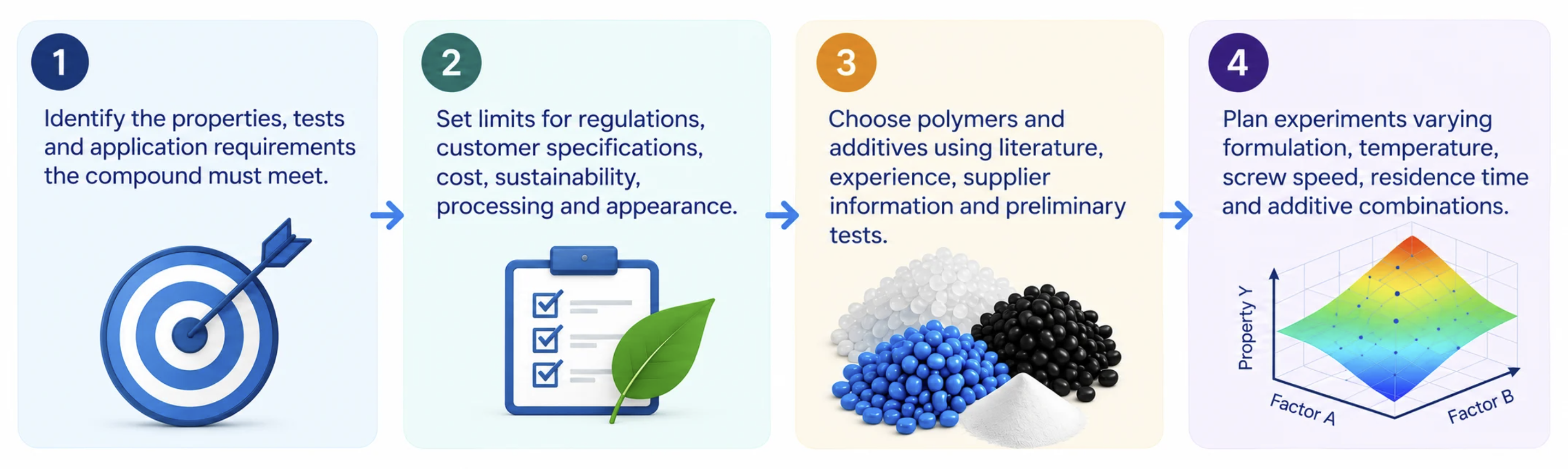
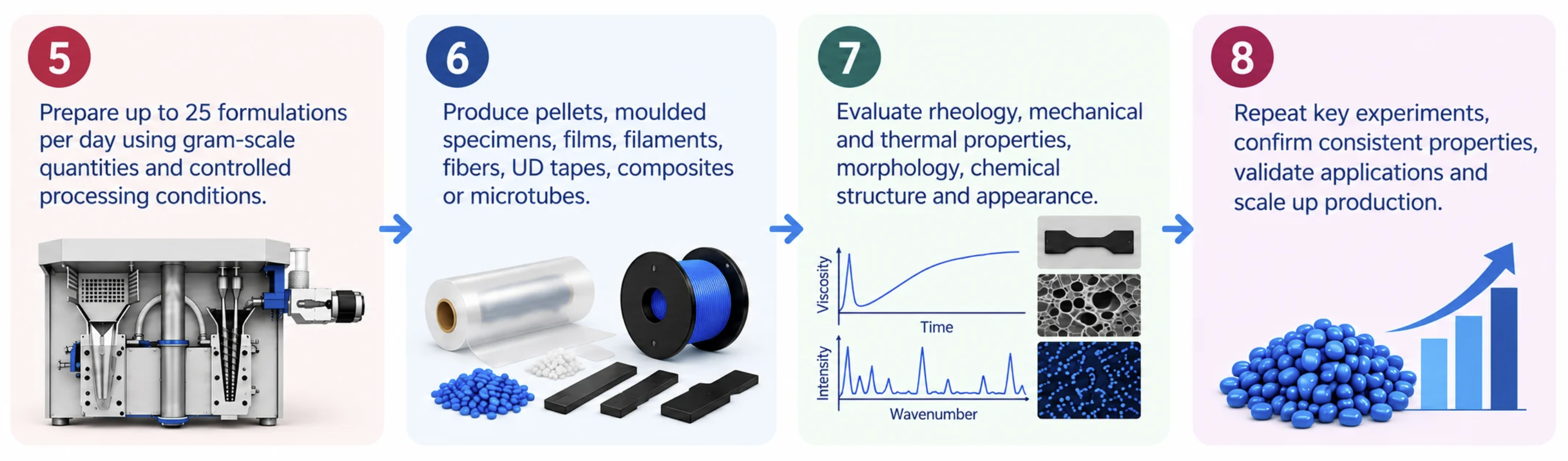
Figure 1. Polymer compound development workflow, from defining targets and selecting materials to compounding, sample preparation, testing and scale-up.
References
- Singh, Diwakar, Ahmad Shakeel, and Clemens Dransfeld. “Unravelling the microstructural organisation of recycled thermoplastic composites made from unidirectional carbon fibre tapes through novel descriptors.” Composites Science and Technology (2026): 111767. Link
- Arrigo, Rossella, et al. “Recycled PP for 3D printing: material and processing optimization through design of experiment.” Applied Sciences 12.21 (2022): 10840. Link
- Mascolo, R., et al. “From waste to 3D printing material: upcycling leather shavings in thermoplastic polyurethane and determining the filament fabrication threshold.” Collagen and Leather 8.1 (2026): 26. Link
- Bovi, Jimena, et al. “Masterbatch-Assisted Dispersion of Bacterial Nanocellulose in Polylactic Acid Composites Prepared by Cast Extrusion.” Journal of Polymers and the Environment 34.2 (2026): 33. Link
- Ribeiro, Rui, et al. “High lignin content polymer filaments as carbon fibre precursors.” Journal of Renewable Materials 13.10 (2025): 1859-1880. Link
- Eryilmaz, Oguz, et al. “Multi-Stage Consolidation Strategy to Improve Impregnation Quality in Thermoplastic UD Tapes.” Solid State Phenomena 387 (2026): 85-93. Link