How Can You Process PVC Successfully on an Xplore Micro-Compounder?
Published: October 22, 2026 · Reading time: 7 minutes
Introduction
Polyvinyl chloride (PVC) is the third most produced plastic in the world and the second most common thermoplastic after the polyolefins. It is found in pipes, window profiles, cables, flooring, medical tubing and packaging. Yet PVC is also one of the most demanding polymers to process. Its processing window is narrow: it must be hot enough to fuse and flow, but every extra degree or second in the melt brings it closer to thermal degradation.
Understanding the Challenges of PVC Processing
During compounding, PVC is exposed to:
- Melt temperatures close to its degradation onset (typically 170–200 °C),
- High shear, which adds frictional heat,
- Long or uneven residence times, especially in dead zones of the barrel and die.
The result is dehydrochlorination: the release of hydrogen chloride (HCl) from the polymer chain. This causes yellowing and browning, embrittlement, corrosion of equipment, and in the worst case a runaway “burn” inside the extruder. Controlling heat, shear and time is therefore the key to every successful PVC formulation, from rigid profiles to plasticized films and PVC nanocomposites.
Not all PVC is the same. Commercial grades are classified by their K-value, a measure of molecular weight derived from solution viscosity. Low K-values (around 55–60) give better flow and suit injection moulding and thin-walled rigid parts, medium values (around 65–68) are typical for pipes and profiles, and high values (70 and above) are used for flexible applications.
PVC is supplied as a powder, so the processing route starts with a dry blend: the resin is mixed with stabilizers, lubricants and other additives, then fused (gelled) into a homogeneous melt by extrusion, calendering or two-roll milling before it is shaped. Rigid (unplasticized) PVC contains little or no plasticizer, is processed at higher temperatures and is used for pipes, profiles and sheets. Flexible (plasticized) PVC contains substantial amounts of plasticizer, which lowers its glass transition and processing temperature and makes it suitable for cables, films, flooring and medical tubing.
Stabilizing PVC Before It Degrades
The weak point of PVC lies in structural defects along its chains, such as allylic and tertiary chlorine atoms. When heated, these sites release HCl and leave behind a double bond. The neighbouring chlorine is then activated, so the next HCl molecule is released more easily. This “zipper” reaction forms conjugated polyene sequences, which absorb visible light and turn the material yellow, then brown and finally black [1]. The released HCl also catalyses further degradation, making the process self-accelerating.
To keep PVC processable, formulators always add heat stabilizers and processing aids:
- Heat stabilizers, such as organotin, calcium/zinc or mixed-metal systems, scavenge HCl and replace labile chlorine atoms with more stable groups.
- Co-stabilizers, such as epoxidized soybean oil (ESO), support the primary stabilizer and improve long-term colour.
- Lubricants and processing aids (e.g. stearates, waxes and acrylic modifiers) control fusion, friction and melt flow.
The challenge grows when new ingredients are added. A good example is PVC nanocomposites with montmorillonite (MMT) clay. To make the clay compatible with the polymer, it is usually modified with quaternary ammonium surfactants. In PVC, however, these decompose into tertiary amines that catalyse dehydrochlorination and cause discolouration [1]. Research groups have therefore looked for alternative clay modifiers, such as non-ionic glycerol and propylene glycol monostearates [1], chelating agents such as poly(ethylene glycol) and palm oil [2], and new organic modifiers designed for plasticized PVC [3]. Each new modifier must be tested for both dispersion and thermal stability, which is exactly where micro-scale compounding becomes valuable.
PVC Micro-Compounding: Insights from Nanocomposite Research
A series of studies from Chalmers University of Technology and SP Technical Research Institute of Sweden used a micro-compounder to develop rigid and plasticized PVC/MMT nanocomposites [1–3]. In the most detailed of these, Sterky et al. [1] processed rigid PVC with 5 phr organically modified MMT in an Xplore 15 cm³ twin-screw micro-compounder at 186 °C and 50 rpm for 3 minutes. The melt was then injection moulded directly into tensile and impact specimens. The same formulations were also prepared on an industrial-type two-roll mill for comparison.
The micro-compounded samples reached a 30–59% higher E-modulus than the unfilled reference, against 6–19% for the roll-milled samples, although part of this gain came from orientation during injection moulding. X-ray diffraction confirmed that PVC intercalated the clay, and a masterbatch route improved dispersion [1,2]. The non-ionic modifiers did not accelerate degradation, but impact strength dropped because of poor compatibility between clay and PVC [1]. Such insights, obtained from just 15 cm³ of melt per run, show how micro-compounding helps researchers separate formulation effects from processing effects before scaling up.
Engineering Solutions for Heat-Sensitive PVC
PVC degradation is not only a formulation problem; it is also an equipment problem. In conventional compounding, several design choices help to keep PVC within its processing window:
- Precise temperature zoning avoids local hot spots that trigger dehydrochlorination.
- Controlled shear and screw geometry limit frictional heating while still fusing the PVC grains.
- Streamlined flow paths without dead zones prevent material from stagnating and burning.
- Short, well-defined residence times reduce the total heat history of the melt.
- Fast cleaning and purging prevent degraded PVC and corrosive HCl from remaining on screws and barrel surfaces.
Precision Control on a Micro Scale with Xplore Systems
Xplore micro-compounders combine conical twin screws with a vertical barrel and a recirculation channel. This lets the user set the residence time precisely, from short single passes to longer mixing cycles, while the small melt volume keeps the heat history low. Introducing materials into the micro-compounder is simple and flexible (Fig.1), with polymer pellets, liquid materials, and powders easily fed through the top hopper, while the liquid-tight barrel design prevents leakage and eliminates the need for forced feeding. The real-time torque signal acts as a practical in-line indicator of melt viscosity: a falling torque at constant conditions can reveal chain degradation, while a rising torque can signal fusion or crosslinking. Optional inert gas purging of the hopper further reduces oxidative stress on the melt.
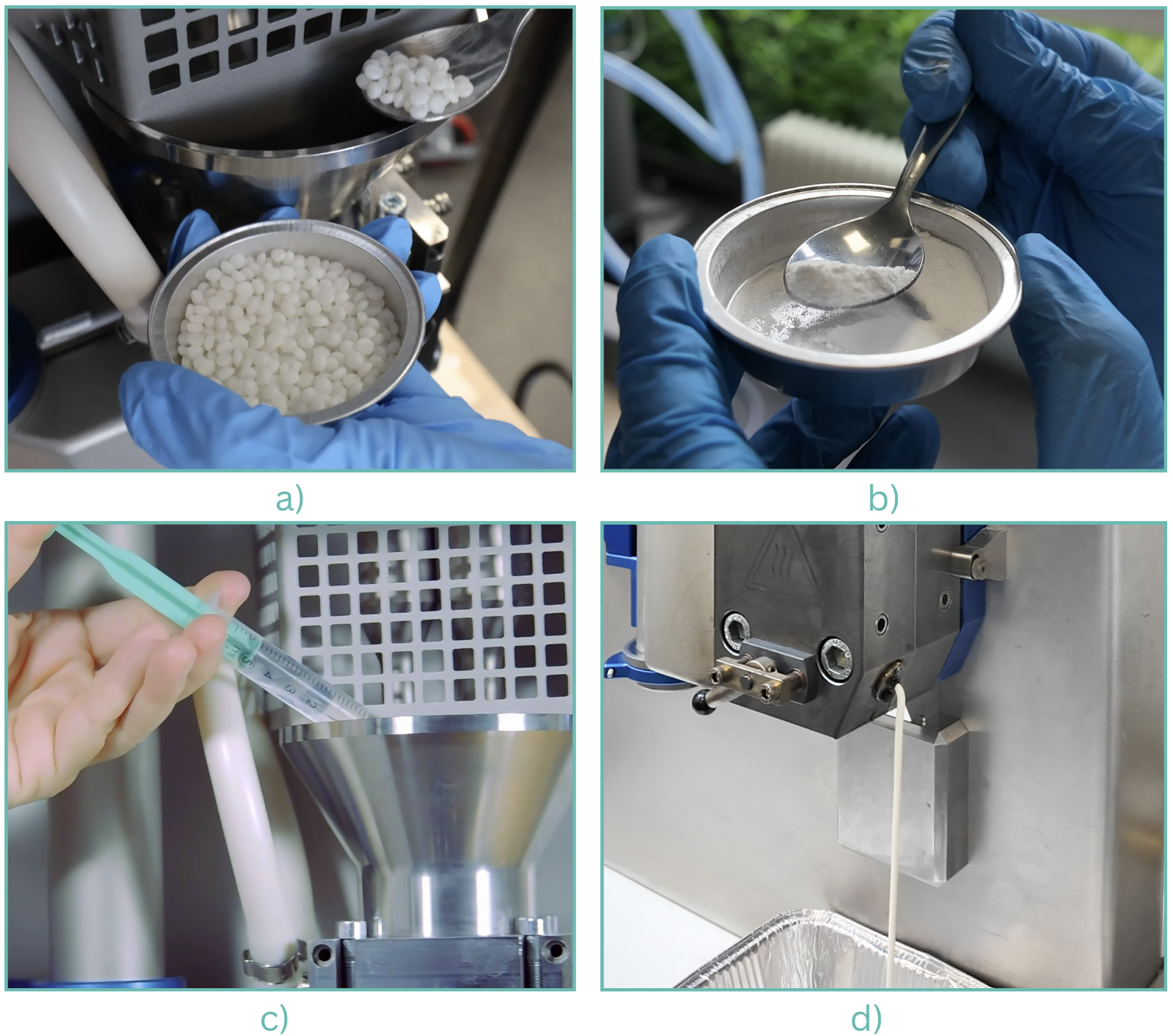
Figure 1. Xplore micro-compounder a) Feeding pellets from top hopper b) Feeding powder from top hopper c) Feeding liquid from top hopper d) PVC material coming out from the die
The compounder can be directly coupled to Xplore injection moulding, cast film, and coating lines (Fig. 2).The coating line is part of Xplore’s Modular Composite Forming Platform, which enables researchers to configure tailoredprocessing solutions and add modules as requirements evolve, without replacing existing equipment. Asdemonstrated by Sterky et al. [1], this integrated approach allows test specimens to be produced from thesame small batch without an intermediate granulation step or additional heating cycle.
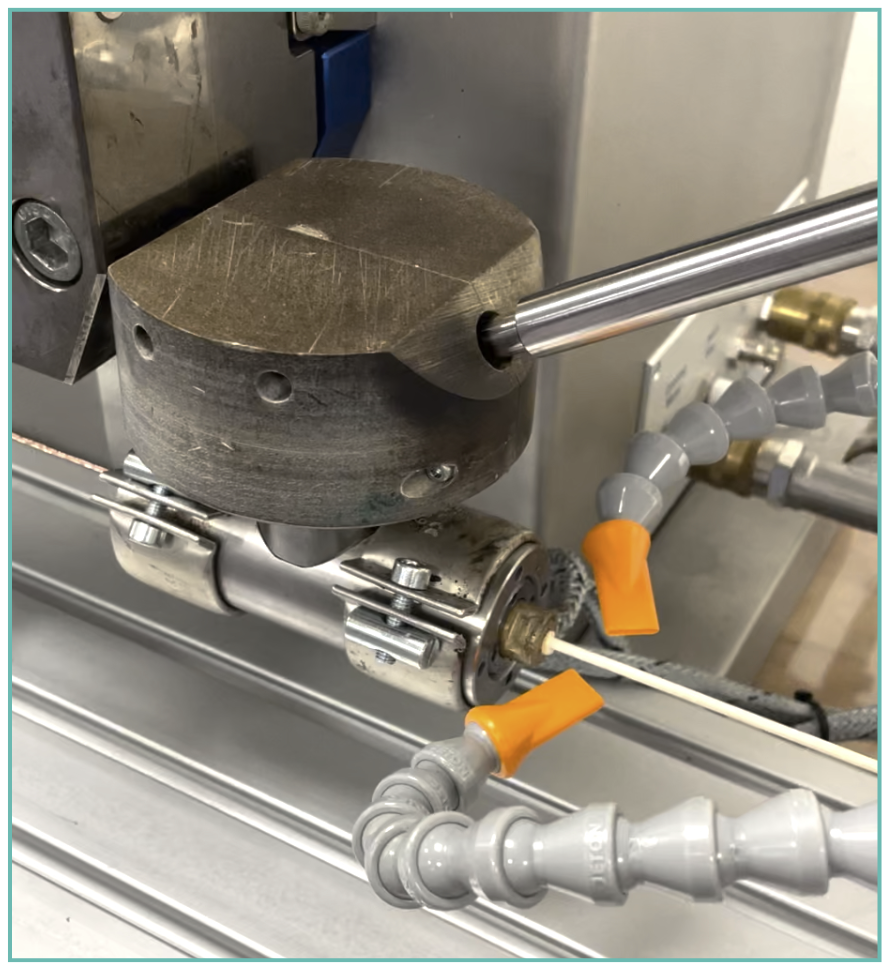
Figure 2. Fibre/Wire Coating Die during coating of copper wire with PVC compound
Why Lab-Scale PVC Processing Matters More Than Ever
The PVC industry is changing fast. Lead-based stabilizers have been phased out, tin- and calcium/zinc-based systems are being optimized, and bio-based plasticizers are replacing traditional phthalates. At the same time, PVC recycling and the development of nanocomposites and other functional fillers create formulations that are more sensitive to heat and shear than ever.
Xplore micro-compounders provide a platform to:
- Screen new heat stabilizers, plasticizers and fillers with only a few grams of material,
- Follow fusion and degradation in real time through the torque signal,
- Compare direct and masterbatch routes for nanofiller dispersion,
- Simulate multiple processing passes for recycled PVC,
- Produce test specimens directly, reducing time, waste and material use in R&D.
By combining precise temperature and residence-time control with micro-scale efficiency, Xplore turns the narrow processing window of PVC from a risk into a well-defined research parameter, helping formulators move confidently from lab-scale insight to industrial production.
References
- Sterky K, Jacobsen H, Jakubowicz I, Yarahmadi N, Hjertberg T. Influence of processing technique on morphology and mechanical properties of PVC nanocomposites. European Polymer Journal. 2010; 46: 1203–1209. Link
- Yarahmadi N, Jakubowicz I, Hjertberg T. Development of poly(vinyl chloride)/montmorillonite nanocomposites using chelating agents. Polymer Degradation and Stability. 2010; 95(2): 132–137. Link
- Petersen H, Jakubowicz I, Enebro J, Yarahmadi N. Organic modification of montmorillonite for application in plasticized PVC nanocomposites. Applied Clay Science. 2015. Link